
|
Gần như mỗi ngày, mỗi tháng, chúng ta đều nghe đến một vài tên tuổi mà sự thành đạt của họ trên các lãnh vực đã làm cho gia
đình và cộng đồng hãnh diện. Họ đã làm cho người bản xứ thay đổi cách nhìn về người tị nạn VN. Và cũng chính họ, sẽ đánh bật
hình ảnh của những kẻ phản bội Brian Đoàn, Ysa Le, Trâm Lê…
Các em xứng đáng là tương lai Việt Nam. Nhất là các em mà trong lòng luôn ấp ủ hình ảnh quê hương quá lá Quốc Kỳ màu vàng
ba sọc đỏ, các em biết nói lời biết ơn với sự hy sinh của các thế hệ cha anh.
Hôm nay, chúng tôi xin giới thiệu một hậu duệ của Quân lực VNCH. Đó là tân Trung tá Võ Phi Sơn ở Miami, Florida.
Võ Phi Sơn vừa được vinh thăng Trung Tá vào ngày 1 tháng 3 năm nay 2009 và đang đảm trách việc cố vấn, huấn luyện cho một
nước Ả Rập.
Là con của cựu Trung tá Phi công Võ Phi Hổ, khóa 17 Võ Bị Quốc Gia Việt Nam, Sơn cùng gia đình may mắn thoát được khỏi
Việt Nam vào những ngày tang thương cuối tháng 4 năm 1975. Sơn đến Hoa Kỳ khi mới lên 5 tuổi, hoàn toàn bở ngỡ trước cuộc
sống mới xa lạ. Trung tá Hổ đã may mắn đoàn tụ gia đình tại đảo Guam, và được đưa về định cư tại Miami, Florida từ cuối tháng
5, 1975.
Nhờ truyền thống gia đình và theo gương bố, là một hoa tiêu khu trục phản lực lỗi lạc của Phi Đoàn 534 thuộc Không Đoàn 92
Chiến Thuật ở Phan Rang, Sơn và các bốn anh chị em lớn lên, học hành thành đạt nơi quê hương mới.
Từ lớp 9, Sơn đã giữ vai trò Chủ tịch của National Honor Society và Science Society tại trường Trung Học. Năm 1985, Sơn đỗ thủ
khoa tại W.R. Thomas Junior High với nhiều giải thưởng lớn của liên bang như: Award of Honor do The National Leadership
Organization trao tặng; The American Legion School Award do The American Legion trao tặng.
Tiếp theo những năm chót trung học, việc học của Sơn thăng tiến mạnh hơn. Sơn còn là một boyscout với các cấp hiệu cao nhất.
Sơn đoạt đai nâu Karate khi vừa học xong trung học. Sơn chơi Trumpet rất xuất sắc, đoạt nhiểu giải tại địa phương và cấp tiểu
bang Đặc biệt, Sơn cũng là một cầu thủ football giỏi như đoạt các giải Football School Athlete of the Year 1988, giải Outstanding in
Football Performance, Academic Achievement and School Leadership. Sơn từng đem giải nhất cho trường về môn chạy bộ.
Ngoài thể lực, Sơn còn giỏi về việc học, nhất là môn toán.
Sơn đã tốt nghiệp Tối Ưu trên tổng số 597 học sinh của lớp 1988; đoạt giải The Best Student of the Year và Outstanding Math
Student Award cùng rất nhiều giải khác với nhiều hiện kim.
Noi theo gương bố, Sơn tình nguyện vào quân đội và được các Nghị sĩ giới thiệu theo học trường Võ Bị West Point khoá 92. Khi
trả lời phỏng vấn của đài truyền hình và báo chí địa phương, Sơn đã nói đến sự trả ơn của mình cho quê hương đã rộng lòng dung
nạp gia đình: “Khi tôi bắt đầu hiểu biết, tôi được nghe nói rằng xứ sở này có nhiều cơ hội cho tài năng phát triển nên tôi đã cố gắng
học hành, và nhờ những cơ hội này, tôi đã có ngày nay. Tôi nghĩ đây là lúc tôi có chút cơ hội đền đáp lại.”
Ra trường, Thiếu Úy Võ Phi Sơn lần lượt phục vụ tại nhiều đơn vị như Sư đoàn 2 Thiết Giáp, Sư đoàn 4 Bộ Binh, Sư đoàn 82
Nhảy Dù. Anh lái các phi cơ trực thăng OH-58 AC, Apache tham chiến tại chiến trường Afghanistan. Lần lượt từ cấp Trung đội
trưởng, đại đội trưởng, Phụ tá ban 3, Ban 1 cấp Trung đoàn. Hiện Trung tá Võ Phi Sơn là Cố vấn phụ trách huấn luyện Trực thăng
cho quân đội các nước Ả Rập đồng minh.
Võ Phi Sơn đã được báo The Miami News giới thiệu với nhiều lời ca ngợi về sự thành công của gia đình nói chung và cá nhân anh
nói riêng .
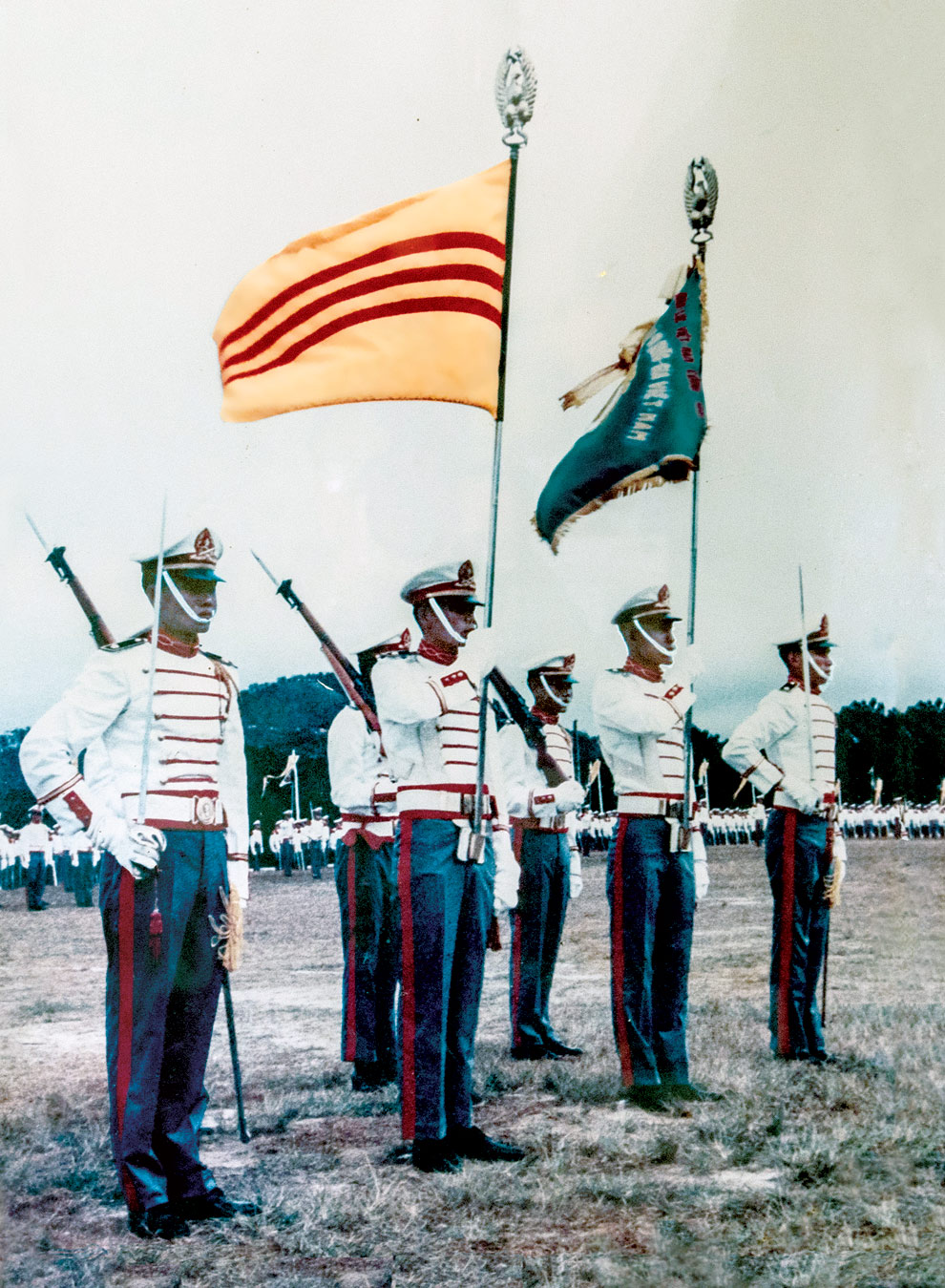
Đặc biệt, tuy hành quân xa xôi, lúc nào Sơn cũng mang theo trong người lá cờ vàng thân yêu của Tổ quốc Việt Nam (xem ảnh).
Bên cạnh những người con ưu tú thế hệ 2 như Đại Tá Lữ đoàn trưởng Dù Lương Xuân Việt, Đại Úy Phi công F-18 Elizabeth Phạm,
Đại Úy Phi công Michelle Vũ, Nhà văn Minh Trần Huy (Giải văn học Gironde Pháp), Philipp Roesler (Bộ trưởng Kinh Tế Đức),
Phi hành gia Eugene Trịnh, Trung tá Hạm trưởng Lê Bá Hùng, Võ sĩ Phan Nam, Trung tá Bác sĩ Paul Đoàn (Y sĩ trưởng Đoàn
Quân Y Viễn Chinh 379 tại Tây Nam Á)…, Võ Phi Sơn đang làm rạng danh người Việt tại quê người.
Chúng ta vinh danh các em, các cháu, không chỉ vì những thành tựu rực rỡ, mà chính vì tấm lòng các em, các cháu luôn hướng về
cội nguồn; không như những kẻ hợm hĩnh chim chưa đủ lông đủ cánh đã vội vã quay lưng với cha anh và phủ nhận quá khứ.
Chúng tôi chúc mừng Trung tá Võ Phi Sơn. Cầu mong sẽ có ngày nghe đến nhiều vị tướng tài ba mang các họ Việt Nam trong
quân đội Hoa Kỳ.
Đỗ Văn Phúc

.
U.S. Officer Revisits His Past in Vietnam
Commander Le with a relative in Hue, where four of his siblings remained trapped when most of his family fled in 1975.
By SETH MYDANS
Published: November 9, 2009
DA NANG, Vietnam — Cmdr. H. B. Le, the first Vietnamese-American to command a United States Navy destroyer, had just
stepped ashore on a formal port call, making an emotional return to Vietnam for the first time since he fled as a young boy on a
fishing boat at the end of the war in 1975.
Justin Mott for The New York Times
Cmdr. H. B. Le heading to a welcoming ceremony over the weekend in Da Nang, Vietnam.
A youthful and smiling man of 39, he bore the weight of the symbolism of cautiously warming military ties between Vietnam and the
United States in the visit over the weekend.
But the welcoming ceremony was delayed by a dispute over a request to display the red Vietnamese flag with its gold star aboard
the Blue Ridge, the flagship of the Seventh Fleet, which had also just pulled into port.
Two hours later the flag was finally raised high on the yardarm, seemingly in accord with the Vietnamese demand and contrary to
American naval custom.
The waiting generals began to smile again, the red carpet was rolled out and Commander Le was free to proceed with his return.
“Stepping ashore was awesome,” he said after landing from his destroyer, the Lassen, which was anchored in Da Nang Harbor.
“To be able to return to Vietnam after 35 years and to be able to do it as commander of a United States naval warship was an
incredible honor and a privilege.”
He was returning to a very different Vietnam from the one he fled at the age of 5 with his parents and three of his siblings. Most
people in this young nation, like Commander Le himself, have no memory of the war.
In the last decade or more, Vietnam has opened its economy, increased trade with the United States and risen from postwar
poverty even as the Communist government maintains control of the news media and political expression.
The city of Da Nang today, with four new bridges, broad streets and an emerging high-rise skyline, is almost unrecognizable to
those who were here during the war.
Despite the changes, the flag-raising dispute and the background of Commander Le’s own story illustrated the complexities of a
relationship that remains shadowed by the war, even as it moves tentatively forward.
“Gradual and steady,” said Carlyle B. Thayer, an expert on the Vietnamese armed forces at the Australian Defense Force Academy,
describing the evolving relationship. “The Americans see a glacier moving, and they call it progress.”
The Vietnamese generals who greeted Commander Le — whose full name is Hung Ba Le — might have reason for mixed
feelings.
Commander Le’s father, Thong Ba Le, who is now 68, was a commander in the wartime South Vietnamese Navy and for a time
held a senior position here in Da Nang. In 1975 he fled the Communist military when his base came under attack by rocket and
mortar fire. The family spent two days at sea before being rescued by a United States Navy vessel.
While he was able to take his wife and his four younger children when he fled, he was unable to rescue four older children, who
were trapped in Hue, Commander Le said. Two of these sons spent several years in Communist re-education camps, he said.
After reaching the United States, the father worked his way up from busboy to manager of a grocery chain in Northern Virginia and
provided college educations for all of his children, including the four who followed him out of Vietnam eight years later in a formal
departure program.
Commander Le is a model of the success of many children of refugees.
A standout scholar and athlete in high school, he graduated from the United States Naval Academy with a bachelor’s degree in
economics in 1992 and was commissioned as a Navy officer. He is married with two children.
“I’m a lucky guy,” he said. “My dad got me out of the country. He did what he had to do. He gave us opportunities to have a good
life in the United States.”
Aboard the Vietnamese tug that brought Commander Le ashore was a man with quite a different set of memories: Chief Engineer
Nguyen Van Ne, 50, said that as a child he had been terrified of American soldiers.
“They burned down my parents’ house,” he said. “They burned it down because they thought we were Communists.” But he said
that those memories were in the past now, and that he would like to visit the United States “just to go and have a look.” He said that
in the United States, people “get a good education and they get ahead, like Commander Le.”
Commander Le learned only a little of the Vietnamese language and very little about his father’s past or his family’s history.
And so his visit on Sunday to his home city of Hue, 50 miles north of Da Nang, meeting the aunts and uncles who are his only
relatives in Vietnam, was a voyage of discovery of his roots.
“Something I recently learned was that my dad was not the first Vietnamese naval officer,” he said. “Back in imperial times, my
great-great-great-great — four or five greats — grandfather served with the emperor. He was like an admiral.”
Commander Le prayed at the family’s ancestral shrines, visited their graves and learned of what he said were his family’s royal
connections in the old imperial capital.
“I had noodle soup by the Perfume River, sitting on little plastic stools,” he said. “I definitely felt like a Vietnamese, just enjoying
that food and the company of my family.”

.
At the helm of a U.S. warship, a Vietnam refugee comes home

Matthew White / U.S. Navy
Cmdr. Hung Ba Le, left, commanding officer of the guided-missile destroyer USS Lassen, discusses the ship's position during
operations at sea Wedneday. Le, the first Vietnamese-American to command a U.S. Navy ship, is returning to the country of his
birth for the first time in 34 years.

Courtesy of the Le family
Cmdr. Hung Ba Le, front left, and his siblings on Thuan An beach, just south of their hometown of Hue, Vietnam, in 1974.

Courtesy of the Le family
Ensign Thong Ba Le, right, receives his Sword of Honor from Vietnamese president Ngo Dinh Diem at his graduation from the
Vietnamese Naval Academy in 1962.

Courtesy of the Le family
Courtesy of the Le family Cmdr. Hung Ba Le, left, and his father, Thong Ba Le.
YOKOSUKA NAVAL BASE, Japan — As South Vietnam crumbled under advancing North Vietnamese forces 34 years ago, 5-
year-old Hung Ba Le and his family escaped and eventually found refuge on a U.S. Navy ship.
This week, he returns to the land of his birth for the first time. And it is a U.S. Navy ship — the guided-missile destroyer USS
Lassen that he commands — that will take him there.
On April 30, 1975, Saigon’s fall was imminent. Le’s father, a South Vietnamese navy officer, had just assumed command of the
Nha Be Naval Support Activity Base after learning the previous commander left the country without warning.
He led his sailors until the last possible moment. But finding himself unable to communicate with his headquarters and fearing the
impending collapse of the government, he ordered his men to go home and be with their families.
In his online memoir, “The Journey of Destiny,” Le’s father wrote: “It was over. There was no one willing to fight because there
was nothing for which to fight. The country was about to collapse under the Vietnamese Communist. I was so desperate, angry,
and upset in my heart.”
Now the younger Le transits the same waters where he and his family sought refuge more than three decades ago.
“I feel blessed to be where I’m at today,” Le, the first Vietnamese-American to command a U.S. Navy ship, said during a phone
interview from sea Tuesday. “It feels very neat to think that we left on a U.S. Navy ship, and to come back on one is pretty
awesome.”
After the fall of Saigon, Le’s family escaped on a fishing trawler. Le’s father led the vessel and its 400 refugees out to sea on April
30, 1975. Numerous times, the younger Le said, the refugees were refused assistance from passing ships.
As Le’s father navigated the boat out to sea, he was leaving behind more than his native country: His four oldest children, living in
the family’s hometown of Hue, were unable meet the rest of the family before the trawler departed.
After days at sea, sleep-deprived and hungry, Le, three other siblings, his parents and the other refugees were taken aboard the
USS Barbour County, a ship participating in Operation Frequent Wind — the evacuation of foreigners and South Vietnamese from
Saigon.
The Barbour County took the refugees to the Philippines.
“The cool ocean breeze could not comfort the wave of sorrow in the heart of this Vietnamese refugee,” the elder Le wrote in his
memoir.
The Le family eventually made their way to Camp Pendleton, Calif., where they were kept in a refugee camp for several weeks.
They soon found sponsorship from an American family and made the trek to northern Virginia, where they would eventually
settle.
With no money, Le’s father worked various jobs to support the family before settling into a job at Giant Food, a supermarket
chain.
“We had some great help along the way from our sponsors,” the younger Le recalled.
Although the family’s journey to gain U.S. citizenship lasted eight years, Le describes his experience in America as one of little
struggle.
“I always felt lucky to come to America when I did,” he said.
In 1983, the naturalization process concluded and the family’s four oldest children were permitted to join the family.
With a family deeply rooted in naval heritage, Le said that as a teenager getting accepted to the U.S. Naval Academy was his
goal.
“I was never pressured over the years from my father to do so,” he said Tuesday as his ship steamed toward its scheduled
Saturday port call to Da Nang with USS Blue Ridge. “But [I] enjoyed being able to follow in his footsteps.”
Le’s father recently told him that following his son’s career, and seeing him command a Navy warship, has added years to his life.
Graduating from the Naval Academy with merit in 1992, Le was designated as a surface warfare officer. Four ships and 17 years
later, he finds himself leading one of the Navy’s premier warships back to a land of which he has few memories.
“It’s amazing to get an opportunity to get to go back, and one that I don’t know if I would have had otherwise,” said Le, who
hopes to reconnect with relatives still in the country. “America gave my family a lot of opportunity, so I enjoy giving back by
serving.”

.
Tàu Hải quân Hoa Kỳ cập cảng Cát Tiên Sa.
Chiều ngày 7/11, cùng lúc hai tàu Hải quân Hoa Kỳ, USS Lassen (DDG 82) và USS Blue Ridge (LCC 19) chính thức cập cảng
Tiên Sa, bắt đầu chuyến thăm thành phố Đà Nẵng.
Tàu hải quân Mỹ cập cảng Tiên Sa.

Tàu USS Blue Ridge là tàu chỉ huy trong Hạm đội 7 của Hoa Kỳ, đóng căn cứ tại Yokosuka- Nhật Bản, có sức chứa hơn 200 sỹ
quan và 1.200 thuỷ thủ.
Đặc biệt, tàu khu trục USS Lassen là tàu Hải quân Hoa Kỳ đầu tiên do một hạm trưởng người Mỹ gốc Việt Lê Bá Hùng chỉ huy.
Hạm trưởng Lê Bá Hùng sinh ra ở cố đô Huế, Việt Nam. Gia đình ông nhập cư sang Hoa Kỳ và định cư tại Bắc Virginia

Ông Lê Bá Hùng chỉ huy trưởng tàu USS Lassen phát biểu tại cuộc họp báo trên tàu

Chuyển hàng từ tàu xuống tiến hành các quan hệ cộng đồng: thăm các nạn nhân chất độc da cam, hội Bảo trợ trẻ em…
Chuyến thăm “đánh dấu lần đầu tiên ông trở lại Việt Nam kể từ khi rời đất nước lúc mới 5 tuổi, và cũng góp phần làm tăng thêm
mối quan hệ hữu nghị giữa 2 nước Việt Nam- Hoa Kỳ” - Ông Hùng phát biểu.
.
.
|